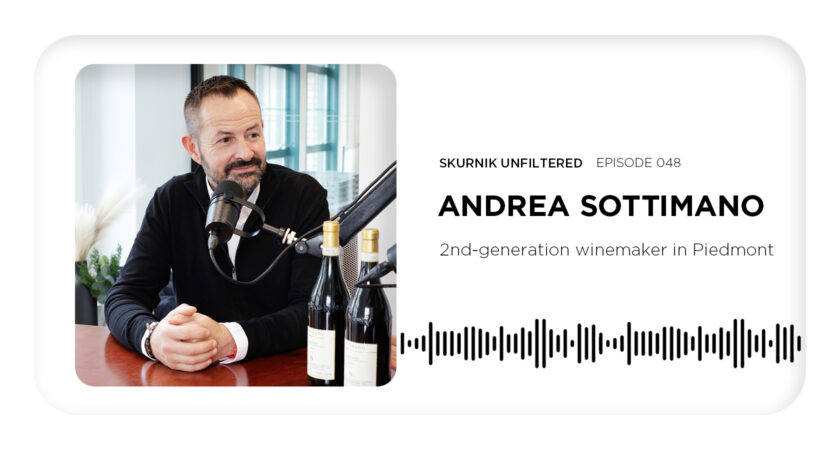
To Andrea Sottimano, wine is not about the winemaker. It isn’t even about the grape—it’s about using both winemaker and grape to express soil. When all things are equal, from farming to cellar practices, the differences that emerge indicate differences of terroir, even at a distance as little as 200 meters. The distinct Cottá, Currá, Fausoni, Pajoré and Basarin crus that he farms in the Neive and Treiso townships of Piedmont speak for themselves.
In this week’s episode, Andrea explains how he was able to elevate his family’s wines with laser focus on the farming, and how a culture of putting friendship over competition makes Piedmont an outlier among the great wine regions of the world. He also makes a case for making wine more affordable and accessible, and tells the story behind the cult favorite Maté, a singular expression of dry, still Brachetto from the vineyard closest to his estate.



Next week, the Queen of Grenache, Marelise Nieman of Momento wines, joins the podcast to talk South Africa.
Be sure to subscribe to Skurnik Unfiltered wherever you find your podcasts so you can stay up to date on all the exciting content to come.
Introduction
Andrea Sottimano 0:03
Everything in nature is balanced. Everything. The only thing unbalanced is human beings. And the problem is the ego. Every producer should take a step back, two steps back, maybe ten.
Harmon Skurnik 0:16
Hey, this is Harmon Skurnik, and welcome to another episode of Skurnik Unfiltered. Today I have with me the maestro of all things Italian when it comes to wine, Mark Fornatale.
Mark Fornatale 0:31
So glad to be here with you, Harmon.
Harmon Skurnik 0:32
Good morning, Maestro. You recently sat down with none other than Andrea Sottimano from Barbaresco. Andrea is a really good friend of yours. He’s become a friend over the years, hasn’t he?
Mark Fornatale 0:42
Oh yeah, like many of the producers. You work here 22 years and you enjoy their wines and these friendships just spark. But the first real impact that we saw of Andrea was when we tasted the 2004 vintage at Vinitaly, like that was an “aha moment” for me because Andrea was slowly pushing his dad to move to organic viticulture and slow things down a little bit from some of the excesses of the 1990s.
Harmon Skurnik 1:15
Well, going back to when we started working with Sottimano, the wines were a rustic.
Mark Fornatale 1:20
A lot of the Piedmonteses say that the wine is made in the vineyard, but honestly, I saw the Sottimano cantina transform before my eyes over the course of working here for so long. And yes, the wine is made in the vineyard. Andrea made that push to go organic, which then was the first step in changing everything into the Sottimano that we know today that makes these incredibly beautiful, elegant wines.
Harmon Skurnik 1:46
How else have the wines changed in Andrea’s tenure?
Mark Fornatale 1:50
His dad was using barriques for one or two years. Andrea started using only barriques from François Frères in Burgundy, who’s the cooper for DRC, of course, but they started lengthening the time that they’d used the barriques. They’d used them for seven or eight years, and then eventually nowadays they’ve eliminated barriques entirely, and the wine is full of large oak casks. That was another slow change that occurred over the years alongside this organic viticulture, which made the skins of the grapes more resistant to a longer fermentation. They were able to ferment not just the ten days or seven days that his dad was doing. Now it’s the 40 days, even for things like Dolcetto and Barbera and Langhe Nebbiolo.
Harmon Skurnik 2:33
Basically, his transformation was a return to the way things used to be.
Mark Fornatale 2:38
We often talk about revolution in Piedmont, whether it was the Barolo Boys Revolution, but then we talk about the small revolutions, the next generation taking over at an estate and making the decisions that they want to make to guide the estate forward. And I think the revolution at the Sottimano cantina, was led by him and done in this incredibly gentle and slow way, and the wines have never been better.
Harmon Skurnik 3:04
He makes a terrific Dolcetto Barbera and a Langhe Nebbiolo, and some people’s favorite wine is Brachetto.
Mark Fornatale 3:11
That is our sneak attack for Sottimano, the dry still Brachetto.
Harmon Skurnik 3:16
…Which is labeled ‘Maté?’
Mark Fornatale 3:18
Maté. It’s a vino rosso because there’s no appellation for Brachetto in the Langhe. The only appellation for Brachetto is Brachetto d’Acqui, which is typically sparkling and sweet. When Andrea’s father found the few rows of Brachetto growing in this Dolcetto vineyard that he thought he purchased, he didn’t really know what to do with them. And so they said, Okay, we’ll try making it like our Dolcetto. We’ll just ferment it dry and still and see what happens. And it became a cult hit. He only makes 250 cases, maybe 300 cases of it, but it has become enormously popular. You know a wine is exciting when you see it go out on all the personal purchases of the Skurnik employees, so when the wine hits, it’s like, “Oh, the the new Maté is here!” and all the kids on the sales support team and the portfolio management teams are grabbing up their bottles of Maté, you know it’s going to be a big hit.
Harmon Skurnik 4:10
I just want to say that the style of the wines are just beautiful. They are really, really expressive when they’re young, but the style of the wines he’s making are aging incredibly gracefully, too.
Mark Fornatale 4:24
We have a library release set right now going back to 2012, and they are knockout wines. Absolutely knockout wines. And the other thing about Sottimano stylistically is that he is Barbaresco from Nieve, and the wines of Nieve are less in your face than the wines of Barbaresco proper, Barbaresco Village. They have an elegance and a suaveness to them that is just exceptional.
Harmon Skurnik 4:54
You mean they have terroir there?
Mark Fornatale 4:56
They have more than terroir. They have terroirissimo.
Harmon Skurnik 5:00
I like that. On that note, let’s listen to your conversation with your friend and mine, Andrea Sottimano. Enjoy.
Mark Fornatale 5:11
We’re here today with Andrea Sottimano from Sottimano Azienda Agricola in Nieve, in Barbaresco, welcoming him back to New York after seven long years of absence. It was 2019, it was before the pandemic, before the world changed. Let me say, we’re we’re really glad to have you back.
Andrea Sottimano 5:30
Yeah, me too. It’s it’s great to be here.
Mark Fornatale 5:32
It’s always a good excuse to open up some good Champagne and Burgundy and old Sottimano wines.
Andrea Sottimano 5:39
It’s always for me, wine is sharing. Wine is not only business. With you, with all the friends we have here at Skurnik, it’s nothing about business, it’s all about friendship, relationships, long-term relationships. It was great, the other night for example, to see people that we know from 20 years ago. And even if it’s seven years that we don’t see each other, it’s like yesterday.
Mark Fornatale 6:11
Pick up where you left off, we say.
Andrea Sottimano 6:13
Exactly. It’s like I’m sorry, I wasn’t here for seven years. And everyone says, Is that much? Who cares? It’s great because in other markets, sometimes they make you feel a little guilty for that. But for me, it’s important because you know that this is not my job. My job is in the vineyards and the cellar. This is like, I would say, fun.
Mark Fornatale 6:40
It’s an honor that, we say you come to “work the market,” and you’re having so much fun. For some people it’s really work, you know what I mean? They struggle to put on a smile and go out there in the market and sell their wines, and you’re just a natural at it.
Andrea Sottimano 6:54
Probably because I remember, you remember, how it was 25 years ago, the wine market in New York. That was a job. I mean, that was really a job because you were visiting some two-star Michelin restaurant, and you were saying, “I’m a Barbaresco producer,” and the sommeliers says, “Italy, right?” I mean… “What grape is this?” No! Grape was way away. Now it’s fun because yesterday, for example, we went all around Manhattan to wonderful places, and everyone says, “Hey Andrea, how are you? I love your Cottá, I love your Pajoré. Whoa, we tried your 2019, fantastic…” I won’t call this a job. This is fun, this is a satisfaction, this is like harvesting the results. Sometimes I even forget to talk about vinification or whatever. We just talk about the vineyards and the soil and whatever, and enjoy.
Mark Fornatale 7:47
What a pleasure.
Andrea Sottimano 7:48
And at the end say, maybe you should say something, just something about the cellar, even just cask, just say a couple of words.
Mark Fornatale 7:57
Because people don’t know that. I mean,
Making better wine with organic farming
Mark Fornatale 8:00
you haven’t been here in seven years, and there have been a lot of changes at the estate, right? I mean, we met each other in 2004 or 2005 when I started working at Skurnik. Sottimano was working with Skurnik for long before that.
Andrea Sottimano 8:13
1996.
Mark Fornatale 8:14
That’s what I would guess. Your dad ran the estate in a certain way that made sense in the 1990s. And then when you finished your studies and really came on board, there were some benchmark vintages, benchmark moments when I think everybody at Skurnik, but also the world, felt a change in the estate at Sottimano. 2004 was one of the big events, coming after the challenging 2002 and 2003, and then tasting the 2004s that you had had a great influence over. And then I remember also the 2010s coming out and being like, Wow, this estate has beat the expectations. The expectations were high, and you leveled them.
Andrea Sottimano 9:00
Hopefully, I don’t know. But you know, my estate, we’re a family. It’s me, my father, and my sister. It’s like a family. No, it’s not “like”—it’s a family. I will be always thankful to my father because at the a beginning, I studied at an enological school, I worked in Bordeaux. My ego was kind of strong at the time.
Mark Fornatale 9:21
As a young man’s would.
Andrea Sottimano 9:24
Young man wants to conquer the world, wants to break everything. I was 21 years old, arriving from Bordeaux, studied at L’Ecole Saint Emillion, and I arrived at home and my father said, Good. I worked for two years in the vineyards. I never saw the cellar, I never saw clients, I never saw anything, just the vineyards. But not even deciding or controlling, working in the vineyards from morning to night, every day, every day. I will be always thankful. I have two kids. I will absolutely do the same because it changed my mind. And after this, another thing that I will be always thankful for is, together with some friends that you know, we began to visit Burgundy. And when I come back from Burgundy, I discovered biodynamics, I discovered people that never talked about vinification. Never. Just about the soil. I said, Whoa.
Mark Fornatale 10:18
Because people were obsessed with vinification, and some of them still are, but in the 1990s, the 2000s and trailing that, people were like, Okay, does it go in large oak or small oak? For Piedmont wines, it was like they were graded on this imaginary rubric of small oak, large oak. No one was asking about what the composition of the soil was in Pajoré or Fausoni.
Andrea Sottimano 10:40
That was our job. Our real job. I realized when I come back home, I said, Hey, we are the same. So from that moment, I felt in love with organic, with biodynamical, and at the beginning, it was a bit of a fight with my father because in Piemonte in the beginning of the 2000s, organic was a word that people didn’t use. Moving into organics was a sort of a fight, but my father is smart, my father is forward-looking, and even he was not really convinced. I remember that. I still remember the face. Even my mother was not convinced at all. And you know what? It was not me, it was the wine that convinced him. I mean, the wines changed. If you try our 1999, 2001, 2004 is the first vintage organic, and then you jump over 2010, you would think they are two producers.
Mark Fornatale 11:44
It’s there, it’s so it’s such a big difference.
Andrea Sottimano 11:46
There is no relation, and the only difference is the organic. We studied the soil, we began to use natural products. If I was going to Burgundy once in a year, after that I was going three times a year just to look at what they were doing, just to see the vineyards, how they were treated, the natural products, the moment that I saw no copper. In organic you can use copper, but copper is a heavy metal, and these people were using natural infusions. That was more difficult for my father because when you enter a room and there is only essential oil, beeswax, seaweeds, my father when he was there, he said, “Are we going to treat the vines or are we going to open a Japanese restaurant here?” Hopefully, he never hear this. It was so funny. It was only natural products, very weird for the time.
Organic farming’s real impact
Andrea Sottimano 12:43
And then we jump to 2016. 2016 was the real cornerstone where we moved completely to a natural approach, where we switched totally into vinification, to a completely traditional. And a lot of people always ask me why we moved. We are working in this way in the vineyards because we want healthier grapes. The skins are more thick, and the result is longer maceration.
Mark Fornatale 13:13
The maceration on the skins went from probably four to six days in your dad’s time to nowadays…
Andrea Sottimano 13:20
Three months.
Mark Fornatale 13:21
For everything?
Andrea Sottimano 13:22
Basically for all the Nebbiolo. Barbera, it’s about one month. It’s huge. Just to give an example, the 1996 Barbera was like three days, four days alcoholic fermentation. Now it’s a month, now it’s 40 days. And why is this? Because from the vineyards, we have skins that are very thick, very healthy, and even after 40 days, the skins are absolutely untouched. Because the problem was that at the time, if I was doing more than four or five days, the skins were falling apart, and you make what we call in Italy polenta, you know, it’s not what you want. The green astringence, some bitter tannins, so it’s balanced now.
Mark Fornatale 14:05
So these organic processes that you took on in the vineyards led to healthier grape skins, which led to longer macerations, which eventually led to this return to an ancient style of vinification.
Andrea Sottimano 14:20
Absolutely. I discovered that, not me, I quote a sommelier from Japan that I was explaining what we do in the vineyards with the grapes, and she keeps smiling and then she said, “Oh wow, that’s what I do every morning. It’s called skincare.” I love that. I said the first thing we do is dry it out, so we use powders, then we nourish with essential oils, and then we protect. And this lady, she looks at me and says, “Yeah, it’s called skincare.” And that’s the result. Results means the skins are absolutely healthy, thick, and that’s why when you do a maceration of a month, and then you do a submerged cap for three months, you need the skins that remain totally intact, and that’s why it’s changed so much in the wine, because you move from a maturation that is active, something that you really do, like maceration, to an infusion. It’s like making tea with tea leaves.
Mark Fornatale 15:24
Yeah, it’s very delicate.
Andrea Sottimano 15:25
And transfers aromas. The word that I discovered with organic is “balance.” Everything in nature is balanced, everything. The only thing unbalanced is human being. Every producer should take a step back, two steps back, maybe ten. And the problem is the ego. All the producers, we have ego, you know that. But I remember something my father told me when I came back from France. He told me, “The worst thing that can happen to you is that someone recognizes your wine in a blind tasting.” Well, you can imagine, arriving from Bordeaux. Are you kidding? It’s exactly what I want! But now I understand what he was saying.
Mark Fornatale 16:04
You’re saying you want to recognize the vineyard?
Andrea Sottimano 16:06
The soil. Some people ask me, Why organic? It’s a great question. Because of this: the wines have more personality. The wines are only talking about the soil where they come from, and not the producer and not the barrique. Another thing that I loved and I stole from French people, there was a sommelier in Paris, and they said if you need more than 10 seconds to explain a wine, there is a problem. If you want, we can talk for hours about the pH and fermentation, about the kind of foudre that we use. But I love the simplicity, I love that. It’s like the producer even doesn’t exist. I love this way because this puts everything in balance. For example, yesterday a good question was, Do you green harvest? Never. Someone said, “But what about in case you have more production?” In the case that I have more production, it means I did something wrong before. Because the vines are in balance, always. If you use too much manure, too much nitrogen, of course the vines would produce extremely high quantities. But if you stay in balance, for example, we use only our own compost, we do cover crop with legumes, the soil is balanced, there is no more than what they need, and even in a productive vintage, probably the vines produce a little more, but that’s because it’s the vintage that’s like this. For example, 2023 is a warmer vintage than average. Not that much, not like 2022, but it’s a little warmer. And so the acidity is good, everything’s good, but the alcohol is 14% to 13.5% ABV. 2023 for me is one of the most elegant vintages in the past 10 years. Not because I did something special, but because that’s the vintage. Nature reacted to a warmer vintage, producing a little more, just a little more, but we didn’t touch anything, just keeping the leaves on, making a lot of skincare. You need a lot of skincare because there’s a lot of sun. But besides that, nothing. It’s important also for the yeast. For example, the two wines here. The yeast for the fermentation of this one is not at all the yeast for this one. There are two different yeasts, and we’re talking about 500 meters. That’s something that a human being, if you selected yeast—I have nothing against selective yeast. Wonderful wines are made with selective yeast, so I’m just talking for myself—but natural yeast gives you different nuances, different layers of taste and aroma, so it’s much more interesting.
Pursuing art instead of profit in Piedmont
Mark Fornatale 18:57
I brought out these two wines today specifically because you’ve opened your cellars to us, and you have a series of library releases which I think are particularly interesting for anybody who’s followed your estate to look back on 2010 or 2012 or 13 or 14. It’s a exciting. There’s a dearth of properly aged, cellar-aged Nebbiolo, Barolo, and Barbaresco, especially in the market. And I just wanted to say thank you for doing that because there are restaurants opening all the time in New York and they always want to add depth to their lists. And having these verticals is something really special for us to be able to offer people. And it gives a window into what you have been working on at the estate, you know, to taste a 2014 vintage, which you know is like superbly elegant, and then you taste the 2023 vintage, you see this line connecting them.
Andrea Sottimano 19:56
That’s what I love, and that’s why we did this, because I would love if a restaurant has 23 and 2014 on the wine list, side by side. If you try that, they say, Whoa, look at that. I mean, the evolution of a vintage, how the aromas are more open, you know, and times are changed, everything’s changed. Now the opportunity to try more mature wines are way less than in the past.
Mark Fornatale 20:24
We talk about this a lot, actually, how the wine world that you and I grew up in, tasting the great wines of the world were much less expensive. But not everybody was chasing after all of the bottles like they do today, and now they’re impossible to touch. We were looking at some Burgundy prices the other day, and it’s like, Wow, oh my gosh, I don’t think I can afford the Premier Crus. Maybe if I’m lucky, I’ll get a little Bourgogne Rouge for certain estates is the best we can do. And now it’s gotten to the point where even Bourgogne Rouge is quite expensive. So people looked in other directions. They went to natural wines, they went to Beaujolais, they went to other zones, but there are still great wines of the world that are out there, especially in Piedmont, I’d like to say with emphasis. Some of the very best wines in Piedmont aren’t all that expensive, especially when you compare them to the great wines of the world.
Andrea Sottimano 21:20
Yeah, from that point of view, honestly, I’m a proud of Piemonte. Oh my gosh. I’m very proud of Piemonte because, you know what? We don’t have a CEO.
Mark Fornatale 21:29
Right. You’re not answering to investors.
Andrea Sottimano 21:31
No, we don’t answer to investors on Monday morning. And that’s true for a reason. We are family. Take Gaja, Giacosa, Conterno, whatever. Name a producer that you love in Piemonte, you call the estate and somebody answers. He’s the guy, yeah. Call Gaja, he’ll answer the phone, yeah. And also in Piemonte we still have the majority of old vines. The problem with old vines is that they produce very small quantities. No really minuscule quantities. If you have a CEO and he makes a calculation like, So you have 20 hectares, you produce 70, 80,000 bottles. Hmm. Something is wrong here, the math is not working like this. So he says, Okay, let’s take it away. We replace with new vines, maybe a little productive, add nitrogen, and let’s go. That’s what happens in basically a lot of regions in the world. We don’t look so much at how much we could produce because that would be useless, because we’re a family. Everyone in Piedmont is a family. Pricing, keeping older vines, everything is fantastic.
Mark Fornatale 22:47
That’s what made me fall in love with Italy, that not everything is about that dollar. Not everything is about the business side of it. There’s really art for art’s sake. And I feel like you guys, the restaurateurs that support you in Italy, the ones who are making everything from scratch, the wife’s in the front of the house and the husband’s the chef, or vice versa—that’s a really special quality that Italy and many European countries have as well that makes you excel at the good life and make art out of these grapes instead of making just profit.
Andrea Sottimano 23:23
Yeah, I totally agree. And in Piemonte, I can add we are the worst commercially.
Mark Fornatale 23:29
Ha! You’re bad business people. Thank God.
Andrea Sottimano 23:32
Talking about business, you talk about marketing strategies and collection. I see that. When I was doing some more portfolio tasting with Silvia Altare, that was funny because we were the only ones with no pictures. Imagine it.
Mark Fornatale 23:45
Everybody else had an iPad on the table.
Andrea Sottimano 23:47
They had an iPad, they had a PowerPoint, they had the canvas, the story of the family in a movie. I remember that. And Silvia said, “What do you have? I have a picture of me and my father.” “Oh, I have the same.” I remember the importer was going on Google, finding some pictures. But you know what? People love that. Because if I arrive with a canvas presentation, a movie of my family animation of whatever, people look at me and say, Well, really? That’s not our job. Like Silvia Altare, like Alfio Cavollotto, like all these people, we are farmers. We are not export manager, and we are not great with marketing. But probably that’s what is keeping Piemonte different, not better, I would say.
Mark Fornatale 24:35
No, it makes it special. It’s a special place in the world, and I’ve always said it because you can walk into a wine shop and for 15 to 25 dollars, you can actually buy a wine that Andrea Sottimano made with his hands, in his vineyard, that he put into the bottle. And that’s more special than just drinking wines from other parts of the world that may cost the same or more, but don’t have that kind of provenance. They may put the nitrogen in the soil, they may max out the profits, they may put whatever label they want on the bottle, and they call it a “small production wine” because they only made 600 labels or whatever it is, but really it comes from a mass production.
Andrea Sottimano 25:17
That’s true. I’m proud to be in Piemonte because we are not competitors. How can I be a competitor of Silvia, Alfio, or Enrica Scavino? We hang out, we go together to have a glass of wine. We have kids, they play soccer together. And that’s something that outside Piemonte is not always the case.
Mark Fornatale 25:35
But also, there’s a Cru, and there are two, three, seven, fourteen different producers that work in that Cru. You’re next to them on a daily basis. You guys are integrated, whereas in Tuscany, it’s much more that château way of thinking. You’ve got the mansion and the vineyards that surround it, and your neighbor’s three miles down the road, and you hope not to see them. Meanwhile, somebody walks into a wine shop, they see a bottle of Sottimano Langhe Nebbiolo, and for $30, they can have a 40-year-old vine Nebbiolo that you farm organically.
Andrea Sottimano 26:07
Organically, and I vinify exactly like a Barbaresco. Long maturation, a little bit of submerged cap, big cask. Exactly the same as we do for Barbaresco. It’s important also from a social point of view, because even if you cannot afford Barbaresco, you can buy Langhe Nebbiolo. The Langhe Nebbiolo for a fraction of the price gives you exactly the same dimension of terroir, the same taste. It’s important because I remember—we remember—when we were 20 years old, which kind of wine we could afford. And when you’re 20, 21 years old, of course you cannot afford it. Maybe yes, but in most cases you cannot afford the Barolo or Barbaresco, and you say, You know what? I know this Langhe Nebbiolo, I know this Gevrey-Chambertin Premier Cru, because it’s not what in our dialect we call the “washout of the cask.” It’s not that. It’s a Barbaresco, just in village dimension, and you can open it, as I say, in 10 years, 15 years with the same dimension of terroir, the same dimension of elegance, as a Barbaresco.
Mark Fornatale 27:18
I love it.
The story of Maté
Mark Fornatale 27:19
You have this little wine that you make, the Maté that we have this enormous cult following for. It’s not your most important wine. We should probably be talking about Barbarescos and single vineyards, but there are a lot of fans out there that will be listening to this who are going to say, “He didn’t talk about Maté at all!” And I was just wondering if you could tell the story of how you discovered that you were suddenly a Brachetto farmer.
Andrea Sottimano 27:46
I don’t know that my father wants that I tell this story, but you know, my father won’t listen.
Mark Fornatale 27:49
He won’t listen to this, I don’t think so.
Andrea Sottimano 27:51
So it was 1971, it’s winter. My father bought the estate, and there was a beautiful vineyard just in front of the house. We’re talking about winter, so there are no leaves, nothing, it was just the naked vines. The guy sold it to my father as a Dolcetto. Then springtime arrived, and my father looked at the vineyard and said, “These are strange Dolcetto vines. These leaves are really strange.” There was no Google, there was no AI. There was no way that to see what the hell is this grape. Summer came, and my father realized way too late that there was no Dolcetto. He said, “What the heck is this grape?” Imagine, we’re talking about 1971. So my father vinified the wine, this grape thing, the only way he knew, like a Dolcetto, like a Barbera, like a Nebbiolo—dry, with long maturation for the time. It was a strange because we were new to it. The rose notes.
Mark Fornatale 28:48
Yeah, very perfumey, floral, geranium spice.
Andrea Sottimano 28:53
Coriadnder, spicy. And he said, “Now the second question is, what am I going to do now with this wine?” It’s one thing to make it, another thing to sell it. We were lucky enough that my German importer loved the wines. Otherwise, my father was thinking about taking it out. Still now, the vines are extremely old. I like this wine because it’s very unique. I remember there were way more producers making this wine in the past. The problem with Brachetto is it is very sensitive to frost, to temperature, to many things, so economically…
Mark Fornatale 29:25
It’s a bit of a disaster, but please don’t stop making it. We have a hundred people that would jump out of a window if you stopped making this wine.
Andrea Sottimano 29:33
You know what? I love this because, even if it’s a simple wine, it’s talking about terroir.
Mark Fornatale 29:39
I have to say that we have a deep bench of Piedmontese producers, and all of you have become my friends. You were at my wedding and all of those things. It really I love working with you, and Skurnik loves working with you. And thank you for being here with us this week and for sharing your wines and your dreams with us. It’s been a dream for us too.
Andrea Sottimano 30:04
Honestly speaking, it’s the producer that should be more thankful to Skurnik because now is not easy. But in the past years—you remember in the 90s—economically, we were really on the edge. And not just Sottimano. I remember a phone call with you when the bank was calling on Monday morning and saying, “Mark, um, do you need wine?” And you said, “Uh Michael [Skurnik], uh, maybe you need more wine?” “I just I just received it.” “Yeah, but maybe you need more.” I remember that, because at the time, you did a lot. The Skurnik family did a lot, all of you, to help all the producers that now you have. People tend to forget a little bit about how was the 1990s. Barolo and Barbaresco was everywhere, but economically, it was not easy. Our job is a full-time job. You see how often I come to New York.
Mark Fornatale 31:10
I understand. You have your hands full.
Andrea Sottimano 31:12
That’s true yeah, trying to do always better and better, starting from the vineyards. Everything passes from the vineyards.
Mark Fornatale 31:19
There you have it. Well, Andrea, thanks for dedicating time to us this week and for being on the podcast with us. I hope to see you again and not in seven years. Maybe in May.
Andrea Sottimano 31:31
In May, yes. You’re right.
Mark Fornatale 31:33
Sounds good. Okay.
Andrea Sottimano 31:33
Sounds good. Thank you, Mark.
Mark Fornatale 31:35
You’re welcome.
Andrea Sottimano 31:35
Thank you.
Skurnik Unfiltered is recorded at Skurnik Wines & Spirits headquarters in the Flatiron District of New York City. If you found the conversation interesting, please consider liking, subscribing, and leaving a review. You can stay up to date on our show and upcoming events by following @skurnikwines on Instagram and visiting our website at skurnik.com